
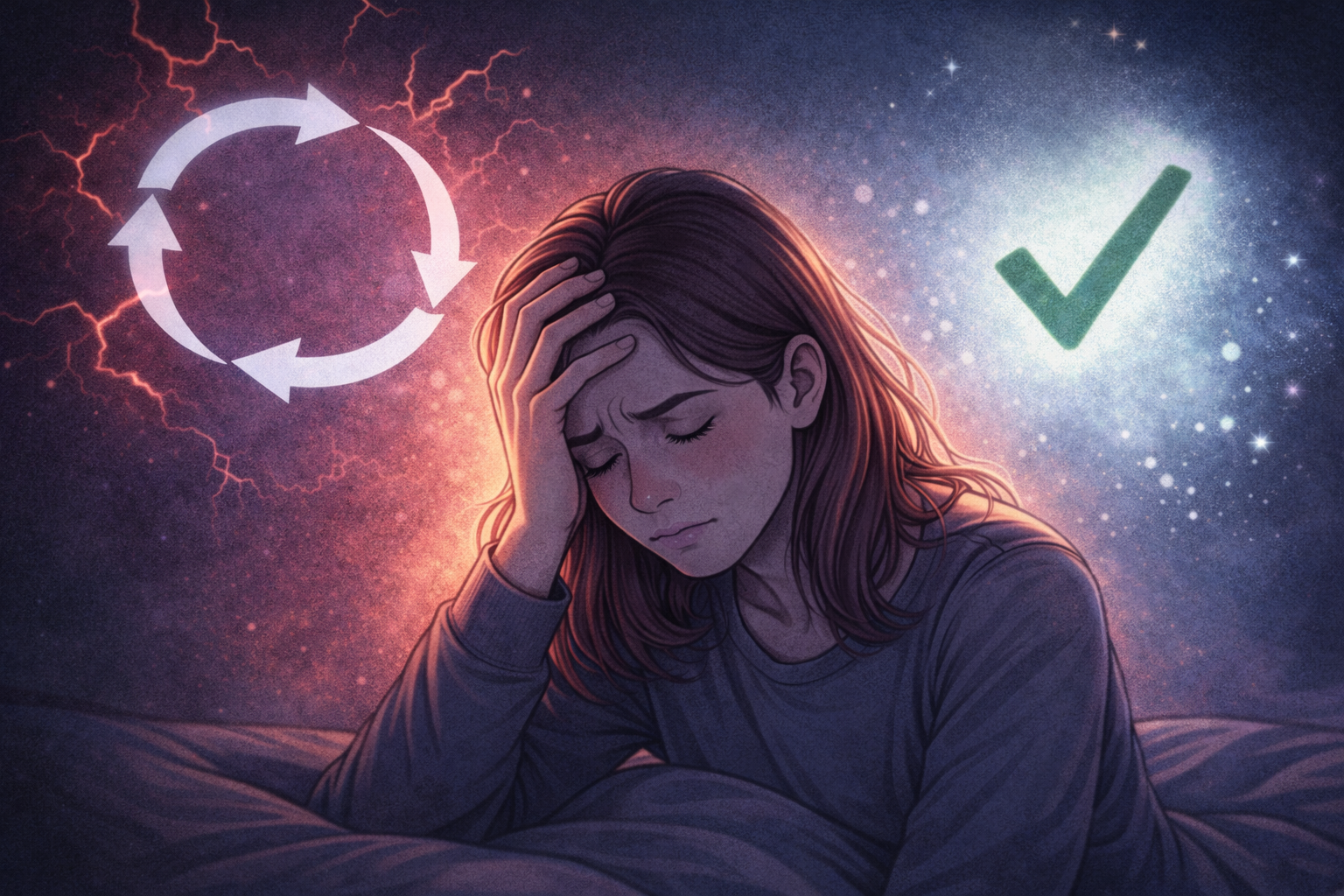
Why certainty calms – and control does not
Many people believe that control brings calm.
Checking everything. Leaving nothing to chance. Making sure nothing was missed.
And yet, controlling thoughts often feel tense rather than calming.
Control comes from uncertainty
The desire for control is understandable.
It appears when uncertainty feels unbearable.
- “What if something went wrong?”
- “What if I missed something?”
- “What if I’m mistaken?”
Control is an attempt to silence that uncertainty.
Why control rarely ends
Control works briefly.
Another check. Another thought. Another review.
But the relief does not last.
“But what if…?”
Certainty works differently
Certainty is not a process.
It is a state.
Something is finished. Closed. No longer open for debate.
The brain seeks closure
Open questions consume energy.
Certainty places a clear endpoint.
And the mind can rest.
Control feels tense – certainty feels calm
Control asks:
“Should I check again?”
Certainty says:
“It’s done.”
Why more control often creates more doubt
Each check introduces new possibilities.
More details. More interpretations. More uncertainty.
Certainty ends the cycle
Certainty does not argue.
It shows.
And that is why it calms.
Letting go does not start in the mind
Letting go happens when nothing remains open.
When there is nothing left to clarify.
Then calm follows naturally.